Skip to content

Framework for cosmography at high redshift

R. Triay [1] [2], L. Spinelli and R. Lafaye [3]

Université de Provence and Centre de Physique Théorique CNRS, Luminy Case 907, 13288 Marseille cedex 9, France

Accepted 1995 October 12. Received 1995 September 11; in original form 1995 June 29

ABSTRACT

We propose a geometrical framework which is adapted for the investigation of large-scale structures at high redshifts in curved spaces, within the standard world model of the Universe. It is based on the embedding of the comoving space into the 4D metric space, which provides us with a useful algebraic representation of the positions of objects in space. In particular, the interpretation and the calculation of geometrical quantities, such as distances between objects, angles, surfaces and volumes, become obvious. Moreover, elements of cartography provide us with a global view of the Universe which accounts for the curvature. A quasar catalogue is used for observational support. This framework is implemented in a routine called UNIVERSE VIEWER.

Key words: catalogues - cosmology: theory - large-scale structure of Universe.

1 INTRODUCTION

The investigation of the space distribution of large-scale structures (LSSs) and candidate formation theories is one of the main trends in cosmology at present. While Euclidean geometry suffices for describing the spatial distribution of available galaxy catalogues, it is clear that such an analysis when extended to quasar catalogues requires geometry of curved spaces because of the high redshift extent (Triay 1981; Fliche, Souriau & Triay 1982). The aim of the present paper is to provide an understandable framework for cosmography at high redshift. A useful definition of the comoving frame is given in Section 2, where the 'distance between quasars' is clearly defined (these objects are assumed to be permanent sources when their observation relates solely to an event, i.e. the emission of the observed photon in the past). An algebraic representation, which provides us with straightforward calculations of distances, surfaces, volumes, orientations, etc., is given in Section 3. Visual inspections of quasar distributions is a powerful tool for the investigation of LSSs and Section 4 gives a (distortionless) mapping of the Universe. The Burbidge & Hewitt (1993; hereafter BH) quasar catalogue (8000 sources) is used as support of our investigation.

It is clear that such a framework is useless if one limits oneself to a zero curvature space, as predicted by the inflationary scenario (Gliner 1965; Linde 1982). Such a scenario is not so clear cut, however, since the short extragalactic distance scale H0=87±7 km s1 Mpc1 (Pierce et al. 1994) suggests a positive curvature (Souriau & Triay 1995). Such an issue reconciles estimated ages for metal-poor Galactic globular clusters 16.5±2 Gyr (Van den Bergh 1991) with realistic estimates of the density parameter Ω00.1 (which accounts for constraints from the big bang nucleosynthesis or the dynamics of galaxies in clusters).

2 THE WORLD MODEL

The basics of the standard world model are given in Weinberg (1972) and Peebles (1993). The geometry of the space-time V4 is described by an RW metric:

(1)ds4=dt2a2(t)dσ2

where t is the cosmic time, a(t) is the (dimensionless) expansion parameter and dσ2 is the metric element on a homogeneous three-dimensional manifold V3, the comoving space. The sign of its curvature scalar K indicates the type of geometry: Riemannian (K>0), Euclidean (K=0) or Lobatchevski (K<0). Let us denote by t0 the present date (the age of the Universe), and all other variables in similar way.

By defining the expansion parameter so that its present value a0=1, V3 becomes the space-time location from where the CMB can be observed as blackbody radiation at temperature T0=2.73±0.03 K (Wilkinson 1990). If the peculiar velocities are neglected, the redshift z becomes a distance indicator and the quasars have constant coordinates on V3. Hence, the cosmic microwave background (CMB) observed from a quasar at redshift z shows blackbody radiation at a temperature T=T0/a(t), where

(2)a(t)=(1+z)1

The space observed through the quasar distribution at redshift z has a curvature scalar given by K(t)=K0a(t)2 (see equations 1 and 2). Most of the calculations use the polynomial

(3)P(a)=λ0a4k0a2+Ω0a+α0,

where the coefficients are dimensionless parameters. One has the reduced cosmological constant λ0=(1/3)ΛH02; the curvature parameter k0=K0H02=λ0+Ω0+α01; the reduced density parameter Ω0=(8/3)πGρ0H02>0, where ρ0 is the specific density of massive particles (dark matter included) at present, and where G is Newton's constant; and finally the parameter α0=(8/45)π3G(kT0)43H022.5×105h2, which accounts for the presence of CMB photons as sources of gravity (Souriau 1974), where k is the Boltzmann constant, is the Planck constant and h=H0/(100 km s1 Mpc1). Although α0 is negligible today, it provides us with a more sensible description of the Universe at the recombination epoch than the usual approach, which describes the radiation-dominated era and the matter-dominated era separately. Let us mention that the above notations are preferred to ΩΛ,ΩR,, because these quantities show different behaviours with time. The deceleration parameter reads q0=Ω0/2+α0λ0.

The Einstein equations provide us with the evolution equation

(4)dt=1H0adaP(a),

and the integration gives the expansion parameter ta(t). The cosmological parameters have to verify the constraints for ensuring an eternal expansion, in particular having a positive cosmological constant λ00. If λ0=0 then the density parameter Ω01, otherwise the related dynamics accounts for a radiation-dominated expansion at an early epoch so that the radiation pressure pushes the space 'out' until the cosmological constant begins to dominate, which makes the vacuum repulsive and makes it avoid the collapse. Diagrams describing the qualitative behaviour of cosmological models with Λ0 can be found in the literature (Carroll, Press & Turner 1992; Souriau & Triay 1995).

2.1 Distances and comoving space

Let Q(x,z) denote a quasar at redshift z. Its line of sight is defined by equatorial coordinates (RA: right ascension; Dec.: declination), which gives a unitary 3-vector

(5)x=(cos(RA)cos(Dec.)sin(RA)cos(Dec.)sin(Dec.))

It turns out that the projection of photon world lines on to V3 are geodesic curves, which provides us with a meaningful definition of distance. The line of sight x becomes a tangent vector on V3 to the projection of the light ray. According to equation (1), the element of geodesic on V3 identifies with the conformal time dσ=dt/a(t). Hence, according to equations (2) and (4), the geodesic distance on V3 of a quasar at redshift z is given by the comoving distance

(6)r=τH0

where τ is the scale-free comoving distance. This is given by the elliptical integral

(7)τ(z)=(1+z)11daP(a).

For a dimensionless investigation of LSS, it is convenient to use a reference manifold of unitary curvature, where the coordinates are angles. Such a representation, which is not valid for a flat space, corresponds either to the 3-sphere S3 when k0>0 or to the unitary 3-hyperboloid L3 when k0<0. Let V^3 denote such a manifold; its metric element reads

(8)dσ^2=|K0|dσ2,

and is obtained from the metric of V3 merely by a normalization. The distance on V^3 reads

(9)τ^=τ|k0|,(k00),

and it is termed angular distance [4] (see equations 7 and 8). Hence, the angular distance of a quasar at redshift z is given by

(10)σ^=|k0|(1+z)11daP(a),

Once the values of cosmological parameters are chosen, the quasars can be located on these spaces by using geodesic coordinates at the observer position G (i.e., the Galaxy at rest with respect to the CMB) according to the following schema:

(x,z)Tk0,Ω0(x,τ)TV~3H0(x,r)TV3k00(x,τ^)TV3

The formulas providing surfaces and volumes in the comoving space V~3 involve the functions

(12)l(τ)={sinτ^/k0if k0>0τif k0=0sinhτ^/k0if k0<0

and

(13)v(τ)={[2τ^sin(2τ^)]/(4k03/2)if k0>0τ3if k0=0[sinh(2τ^)2τ^]/[4(k0)3/2]if k0<0

For practical purposes one limits oneself to geocentric shapes (circles and cones), and one has

  1. an arc of a circle comoving radius, which extends over θ radian (θ=2π for a circle), with a length equal to θl(τ)
  2. the portion of a sphere extending over ω steradian (ω=4π for a sphere), which has a surface area equal to ωl2(τ);
  3. the volume by ωv(τ)

3 ELEMENTS OF COSMOGRAPHY

For a flat space (k0=0), the Euclidean structure defined on the comoving manifold (either V~3 or V3) provides us with an obvious algebraic representation of the space distribution of quasars. However, it is clear that k00 requires a different structure, which is the matter of this section. The solution (Triay 1981) is to embed V^3 into the metric space R4 with a suitable structure which accounts for different geometries (either the Riemannian or the Lobatchevski: see equation 11).

3.1 Geodesic reference frame

A reference frame on V^3 identifies with a mapping R:R4V^3; it is the choice of a particular location on V3 as well as the orientation of the tangent space at this location. Hereafter, RT denotes a reference frame so that the position of quasar Q(x,z) is given by the 4-vector

(14)Q=RT1(x,τ^)={(xsinτ^cosτ^)if k0>0(xsinhτ^coshτ^)if k0<0

where τ^=τ^(z) is the angular distance (see equations 5 and 9). It is interesting to note that:

  1. the tangent vector to the geodesic τ^Q, which reads(15)Qt=dQdτ^={(xcosτ^sinτ^)if k0>0(xcoshτ^sinhτ^)if k0<0at the Galactic position on the geodesic τ^=0 identifies as a matter of fact to the line of sight x;
  2. the Galaxy position (T) is given by the 4-vector(16)T=RT1(T)=(031)where 03 is the null 3-vector, according to equation (15), with τ^=0;
  3. if k0>0 then a quasar at a distance τ^=π can be observed over the whole sky (i.e., towards any line of sight x).

Let ,4S denote the scalar product with a suitable signature:

(17)Signature={(++++)if k0>0(+++)if k0<0,

Hence, according to equation (14), for any 4-vector Q which locates a quasar position on V^3, we have

(18)Q,Q4S={1if k0>01if k0<0.

3.2 Calculation of distances and angles

The comoving distance τ=τ^/|k0| (see equation 9), between two quasars Q1 and Q2, involves the calculation of the related angular distance

(19)Q1,Q24S={cosτ^if k0>0coshτ^if k0<0.

where the coordinates of 4-vectors Q1 and Q2 are defined according to equation (14). Therefore, we have\

  1. for k0>0,(20)cosτ^=cosθ12sinτ^1sinτ^2+cosτ^1cosτ^2,where cosθ12=x1,x23 is the scalar product in the three-dimensional Euclidean space R3;
  2. else if k0<0,(21)coshτ^=coshτ^1coshτ^2cos(θ12)sinhτ^1sinhτ^2.

Let y1 (respectively yT), be the line of the quasar Q1 (respectively on the Galaxy), as observed from the quasar Q2. The angular separation θ1T between these directions is merely given by

(22)θ1T=cos1(y1,yT3).

To avoid cumbersome calculations, it is convenient to choose a reference frame related to quasar Q2 so that

(23)RQ21(Q2)=(031)

Hence if k0>0, then the Galaxy and the quasar Q1 positions are respectively given by

(24)RQ21(T)=(yTsinτ^2cosτ^2)

and

(25)RQ21(Q1)=(y1sinτ^cosτ^)

where τ^ is given by equation (19). Since the scalar product RQ21(T),RQ21(Q1)4S=cosτ^1 is invariant, we obtain

(26)y1,yT3=cosτ^1cosτ^cosτ^2sinτ^sinτ^2

Similarly, if k0<0 then we obtain

(27)y1,yT3=cosτ^cosτ^coshτ^1sinτ^sin(τ^2).

3.3 Euclidean neighbourhood

When using efficient 3D routines implemented on graphics-dedicated computers, it is interesting to have three-dimensional Cartesian coordinates of structures within their vicinity. Let us assume that the structure lies near quasar Q2; the goal is to calculate the three-dimensional Cartesian coordinates of quasar Q1. These are given by the 3-vector τy1 where (y1,τ)Q2 are the geodesic coordinates (see equation 11).

The coordinate transformations can be calculated by using the group of V3 symmetries, which correspond to displacements from T to Q2 and 3D rotations of vector y1 'in the sky of Q2'. These rotations are performed by means of matrix MSO(3) defined in term of Euler's angles (ϕ,θ,ψ). For the trivial case k0=0, the displacements on V3 correspond obviously to translations in the Euclidean three-dimensional space. For k00, one uses displacements on the reference manifold V^3. They are performed by means of matrix RQ21RT (equations 16 and 23).

Let us denote πx2+=x2x2t the 3×3 projection matrix upon x2, where x2t is the covector transposed of x2 and πx2=(13x2x2t) the orthogonal projection matrix, where 13 is the 3×3 unity matrix. A little algebra shows that

(28)RQ21RT=(μx2πx20303t0)+C,

where μx2SO(3) is a 3×3 matrix which accounts for a rotation about x2, and C is the 4×4 matrix given by

(29)C=(cos(τ^2)πx2+sin(τ^2)x2sin(τ^2)x2tcos(τ^2))

if k0>0, otherwise (k0<0)

(30)C=(cosh(τ^2)πx2+sinh(τ^2)x2sinh(τ^2)x2tcosh(τ^2))

For the present purposes, the matrix μx2 can be reduced to unity μx2=Π3, since rotations can be performed on y1 later on.

Therefore, the line of sight of quasar Q1 in the sky of Q2 is given by the following unitary 3-vector: if k0>0 then

(31)y1=sin(τ^1)x1+[sin(τ^1τ^2)sin(τ^1)]τ^1,x23x2sinτ^

where τ^ is the angular distance between Q1 and Q2 given in equation (9), otherwise if k0<0 then

(32)y1=sinh(τ^1)x1+[sinh(τ^1+τ^2)sinh(τ^1)]x1,x23x2sinh(τ^)

It is clear that these formulas are in agreement with equations (26) and (27).

3.4 Non-singular embedding

The quasars positions on V3 (or V^3) are deduced by scaling from V^3. However, it is clear that the above system of coordinates is not adapted for investigations which require variations of k0 from negative to positive values, since T goes to infinity when k00. In order to avoid this singularity, the origin of the reference frame on V3 must be shifted so that T lies at the origin. Hence, we obtain the following coordinates:

(33)QT(x,τ)=1H0|k0|[RT1(Q)RT1(T)]

see equations (16) and (14). Hence, one can easily check (by expanding the trigonometric or exponential functions at k0=0) that such a coordinate system describes continuous deformations of the quasars distribution at k00,

(34)QT(x,τ)τH0x.

4 CARTOGRAPHY OF THE UNIVERSE

The main difficulty in addition to that of geometrical effects is to disentangle real structures and artificial ones. It turns out that we obtain sensible results by using orthogonal projections of V3 on to two-dimensional planes. A maximum of six orthogonal 2-planes are required for having complementary information. Let pk=1,3 be unitary orthogonal 3-vectors; they can be written in terms of 3-vectors forming the local frame ek=1,3 (by using Euler's angles ϕ,θ,ψ) [5]. The basis of a projection plane consists of two 4-vectors chosen among the following:

(35)P0=(031)Pi=(pi0)(i=1,3).

The projections are designated by means index couples 'i-j' related to the 4-vectors defining the plane. These maps are classified with respect to geometrical properties in two categories:

  1. the edge-on views (0-i), with 0<i3. If k0>0 then the whole Universe is projected on to the unitary disc, else (k0<0) within a unitary hyperbola, and T is projected on to the edge of the map;
  2. the face-on views (i-j), with 0<i<j3. The whole Universe is projected on to a disc, and T is projected on to its centre.

In the following subsections, these maps are discussed regarding the distortion problem and the recognition of selection effects in observation. Let us mention that the selection effects depend either on the line of sight x or the redshift z, with no correlation between these variables [6], which makes the bogus structures easily recognizable since they show geocentric shapes.

4.1 Global views of the Universe

The coordinates of quasars Q(x,z) are given by the following scalar products, ui=Pi,RT1(x,τ^)4 in the Euclidean space R4. We obtain

(36)u0={cosτ^if k0>0coshτ^if k0<0(37)ui=x,pi3×{sinτ^if k0>0sinh(τ^)if k0<0.

The zone of obscuration arising from the Galactic plane appears clearly when one chooses the north galactic pole (Dec.=90) as vectors p1 and p2 lying in the disc of the Galaxy (RA=0, Dec. 0°). We choose Ω=0.2 and λ=1.2 in the case of positive curvature (k0=0.4) world model or λ=0 in the case of negative curvature (k0=0.8), as support of our analysis on the geometrical effects.

4.1.1 Edge-on-views

In the edge-on views [views (0i)i0] the Galaxy is located at (1,0), the border of the distribution. The global characteristics of these maps depend on the sign of the curvature parameter k0.

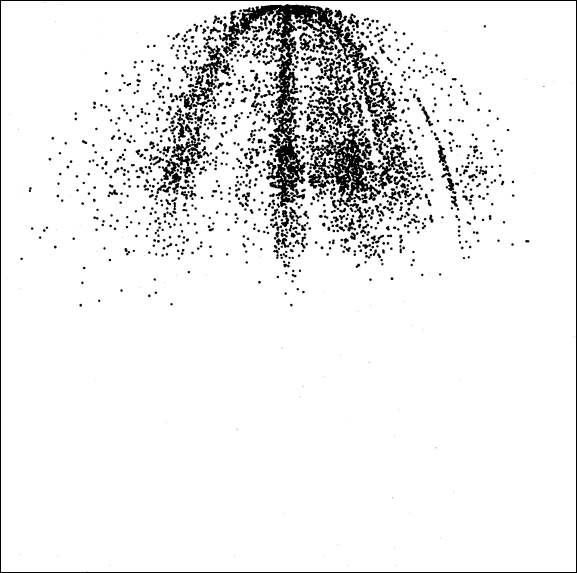
  1. If k0>0 then the quasar distribution lies within a unitary disc, since u02+ui21. In Fig. (1) the Galaxy is located at the top edge of the disc. Structures along the ellipses are selection effects which depend on the line of sight. The related equation reads βiu02+ui2=βi where βi=x,pi321. The obscuration zone of the galactic plane is responsible for the lack of dots along the edge of the unitary disc (ellipse of unit ellipticity), since p1 lies towards the North Galactic Pole. The horizontal structures along chords at constant u0 (i.e., curves at constant τ^) are a result of selection effects on redshift.
  2. If k0<0 then quasar distribution lies within a unitary hyperbola, since u02ui21: see Fig. (2). Similarly, as above, the bogus structures owing to redshift selection effects lie at constant u0, while the selection effects on the line of sight lie along hyperbolae of equation βiu02ui2=βi1.

Figure 1[Figure 1] Edge-on view (0-1) of the Universe through the space distribution of the BH quasar catalogue, by assuming a positive curvature k0=0.4. The whole Universe is projected on to a unitary disc, and the Galaxy is located at the top edge, where the number density is the highest. The bottom edge of the distribution corresponds to a redshift z4, which shows that the sample of all known quasars fills, in space, slightly more than the half of the Universe (the unitary disc is not drawn). There is a lack of sources along the edge of the unitary disc owing to selection effects in observation which corresponds to the obscuration zone of the galactic plane. Similarly the structures along ellipses are a result of selection effects which depend on the line of sight. The horizontal structures (along chords) are a result of selection effects on redshift.
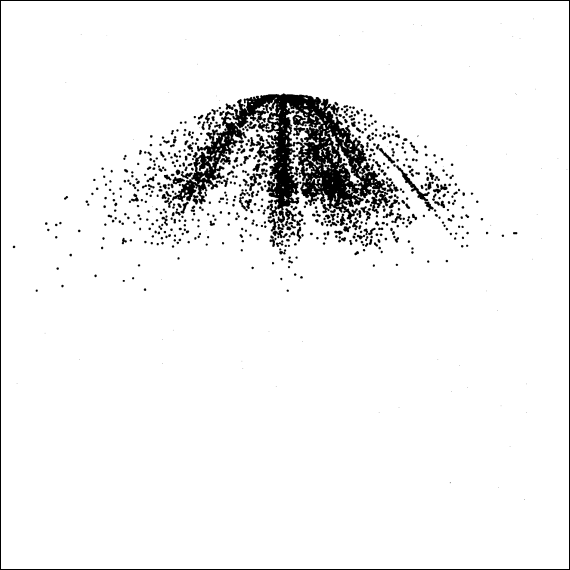
Figure 2[Figure 2] Edge-on view (0-1) of the Universe, by assuming a negative curvature k0=0.8. The space distribution of the BH quasar catalogue is projected within a unitary hyperbola up to redshift z4. The lack of sources along the edge of the hyperbola is owing to the zone of avoidance in the Galactic plane.

4.1.2 Face-on views

In the face-on views [views (ij)0<i<j3], the Galaxy is located at (0,0), the centre of the diagram, and the quasar distribution lies within a disc; see Figs 3 and 4. The pencil beams are projected on to radii, which defines the shape of related bogus structures owing to selection effects on the line of sight. The vertical zone of avoidance is caused by the obscuration of the Galactic plane. Let us mention that the bogus structures owing to redshift selection effects cannot be recognized in these maps [7]. While these projections offer fewer possibilities than the edge-on views for the identification of selection effects, they provide us with complementary information.
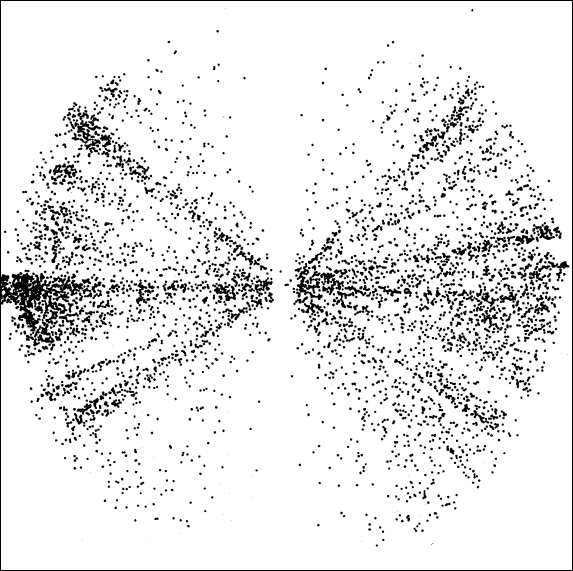
Figure 3[Figure 3] Face-on view (1-2) of the Universe through the space distribution of the BH quasar catalogue, assuming Ω0=0.2 and λ0=1.2.
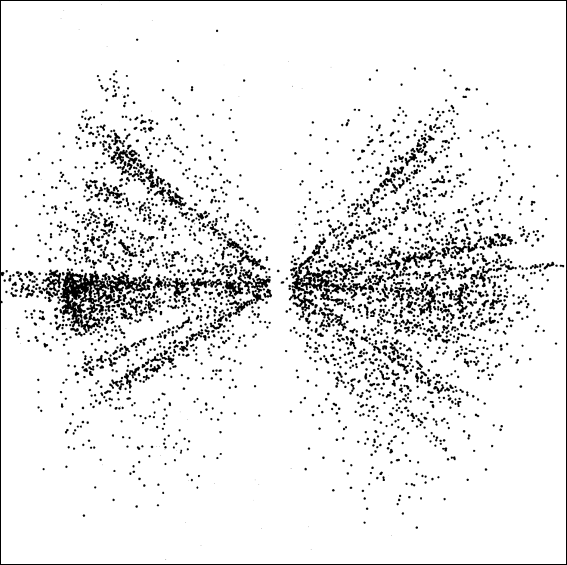
Figure 4[Figure 4] Face-on view (1-2) of the Universe through the space distribution of the BH quasar catalogue, assuming Ω0=0.2 and λ0=0.

4.2 About the distortion problem

The main problem for visual analysis is related to the distortion effect (e.g., as in maps of the world). To investigate such a problem we have to calculate the image of the volume element on V^3 using the above projections. It turns out that the volume element dV can be written as follows:

(38)dV=d(cosν)dϕ×{sin2(τ^)dτ^if k0>0sinh2(τ^)dτ^if k0<0,

where ν is the angle defined by x,p33=cosν. Hence, it is obvious that the image reads dudv. Indeed, for the edge-on view, the Jacobian of the transformation of variables (τ^,cosν)(u,v) reads

(39)J[(τ^,cosν)(u,v)]={sin2(τ^)if k0>0sinh2(τ^)if k0<0,

and the volume element may thus be transformed using dV=dudvdϕ. Hence, the integration over ϕ provides us with dudv, the image of the volume element on the map [8]. The face-on view shows the same advantage. Indeed, the case k0>0 is obvious, for symmetry reasons, while for k0<0 we use the variable transformation [τ^,u=sinh(τ^)cos(v),v=sinh(τ^)cos(ϕ)](τ^,v,ϕ) the Jacobian is equal to sinh2(τ^). Therefore, we understood that the shapes of LSSs are preserved [9] in the projections which provide us with the above maps, which ensures that the structures that can be seen on these maps do not correspond to artefacts.

5 CONCLUSION

This paper introduces an efficient geometrical framework for the investigation of large-scale structures at high redshift in curved spaces. The world models are given by Friedmann-Lemaitre models of Universe. This framework is implemented in a free-share routine (Universe Viewer) developed on a Unix station, which is available on the internet network at node cpt.univ-mrs.fr/cosmology/UV.

ACKNOWLEDGEMENTS

We thank Andrew Laycock for useful comments on the manuscript.

REFERENCES

  • Bigot G., Triay R., 1990, Phys. Lett. A, 150, 227
  • Burbidge G., Hewitt A., 1993, ApJS, 87, 451 (BH)
  • Carroll S. M., Press W. H., Turner E. L., 1992, ARA&A, 30, 499
  • Fliche H. H., Souriau J. M., Triay R., 1982, A&A, 108, 256
  • Gliner E. B., 1965, Sov. Phys. JETP, 22, 378
  • Linde A. D., 1982, Phys. Lett. B, 108, 389
  • Peebles P. J. E., 1993, Principles of Physical Cosmology. Princeton Univ. Press, Princeton
  • Pierce M. J., Welch D. L., McClure R. D., Van den Bergh S., Racine R., Stetson P. B., 1994, Nat, 371, 385
  • Souriau J. M., 1974, in Colloques Internationaux du CNRS, 237, 59
  • Souriau J. M., Triay R., 1995, Phys. Rev. D, submitted
  • Triay R., 1981, thèse 3ème cycle, Université de Provence, Provence
  • Van den Bergh D. A., 1991, in PASP Conf. Ser. 13, The formation and the Evolution of Star Clusters. Astron. Soc. Pac., San Francisco, p. 183
  • Weinberg S., 1972, Gravitation and Cosmology. John Wiley & Sons, New York
  • Wilkinson D., 1991, in Blanchard A., Celnikier L., Lachièze-Rey M., Trân Thanh Vân J., eds, Rencontres de Blois 1990, Physical Cosmology - Proc. 25th anniversary of the Cosmic Background Radiation Discovery. Editions Frontières, Gif sur Yvette, p. 97

  1. The European Cosmological Network ↩︎

  2. E-mail: triay@cpt.univ-mrs.fr ↩︎

  3. Stage Informatique du DEA de Physique Théorique 94/95 ↩︎

  4. To avoid confusion with notations given in the literature, let us write the RW metric as follows:

    ds2=dt2R2(t)[dχ21κχ2+χ2(dθ2+sin2θdϕ2)]

    where κ=k0|k0|1 is the sign of the curvature, and if it is not zero then a(t)=R(t)H01|k0|1/2, otherwise a(t)=R(t)H01 and finally one has the radial coordinate

    χ={sinτ^if k0>0τif k0=0sinhτ^if k0<0. ↩︎
  5. For example, p3 (RA=α, Dec.=δ), p1 is given by a rotation of angle ψ about p3 of a unitary vector e3×p3, and p2=p3×p1. ↩︎

  6. Indeed, the first one is related to surveys sampling, such as pencil beams, ..., when the second is based on spectroscopic criteria, such as the chromatic sensitivity of receivers, ... The identification of main emission lines Mg II, Ly α N v, C III, C IV, Si IV, ... is possible when they lie within the observable wavelength range. ↩︎

  7. Indeed, a region of the Universe at redshift z is projected within a disc of radius given by sinτ^(z) if k0>0 or sinhτ^(z) if k0<0, which does not indicate the distance. ↩︎

  8. Applied to the case of S2 sphere projected on to a diameter (one-dimensional disc), it is a well-known theorem. ↩︎

  9. In other words, the image of the uniform measure on V^3 is still uniform. ↩︎

Dernière mise à jour:

Fait avec ❤️